
Miracle Mile is a small but remarkable film from 1988, written and directed by Steve de Jarnatt. The story begins with a meet-cute romance between Harry and Julie, played by Anthony Edwards (Top Gun, Zodiac) and Mare Winningham (St. Elmo’s Fire). Miracle Mile moves at such a brisk pace, that the relationship is established by end of the opening credits, with hardly a line of dialogue. The sweetness of these two actors carries through to the end, and helps the film to retain its emotional core as the tension rises.
(Minor spoilers follow, but I won’t give away the ending)

Harry and Julie spend time getting to know each other after meeting at the La Brea Tar Pits. They make plans to go on an official first date after Julie gets off work at midnight. Harry oversleeps and heads to the rendezvous point at Johnie’s Diner three-and-a-half hours late, unsure of what else to do (by the way, how did we ever get by before cell phones?). Read more…
Robert Altman’s 3 Women (1977) is a unique viewing experience. It flouts easy genre categorization, and carries the distinctive air of an otherworldly dream within a contemporary (for 1977) milieu. Is it a conventional drama? Certainly not. Is it horror? Still no, though Gerald Busby’s musical score might lead you to believe otherwise. It’s a mixture of elements that produces a calculated dissonance, and it’s an experimental gem from Altman’s monolithic career.
3 Women stars Sissy Spacek as Pinky, and Shelley Duvall as Millie. Pinky is a slob, childlike, and relatively guileless with men. Millie is classically feminine (please take that as a value-neutral statement) though perhaps only superficially so; she is well dressed, cooks, lives in an immaculately-kept apartment, and flows over with fashionable lifestyle advice. Who is the third woman? While the cast list is likely to tip viewers off that the third woman is Willie, local artist and businesswoman played by Janice Rule, 3 Women is essentially a two-woman show for most of its runtime.
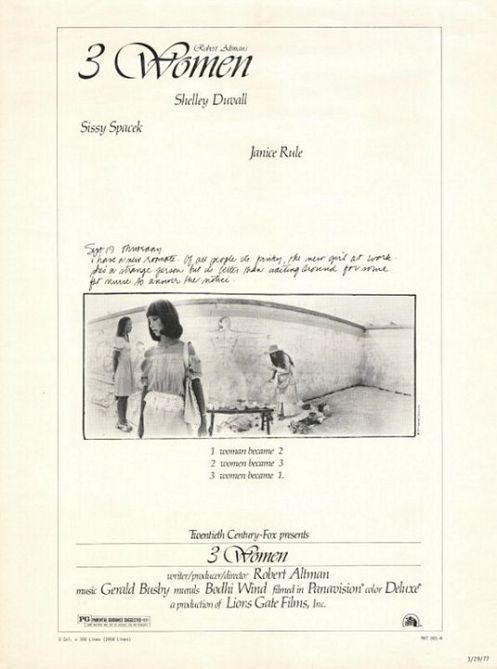
Pinky starts a new job at a therapy center, assisting elderly patients with water aerobics and other activities. On the job, she meets and is trained by Millie. The two women take a liking to one another and they quickly begin to display an uncanny connection to one another. Plot-wise, there is not much more than that. There are more characters, but their presences are mostly incidental. Read more…
This is long overdue, but I finally have time to share a few thoughts on Rogue One: A Star Wars Story, the latest Disney/Lucasfilm tentpole. Cutting to the chase, Rogue One is terrific. While the film is not completely without fault, I find that the majority of my criticisms fall in the “nitpicks from a Star Wars fan” category, and do not add up to anything that seriously hinders the experience.
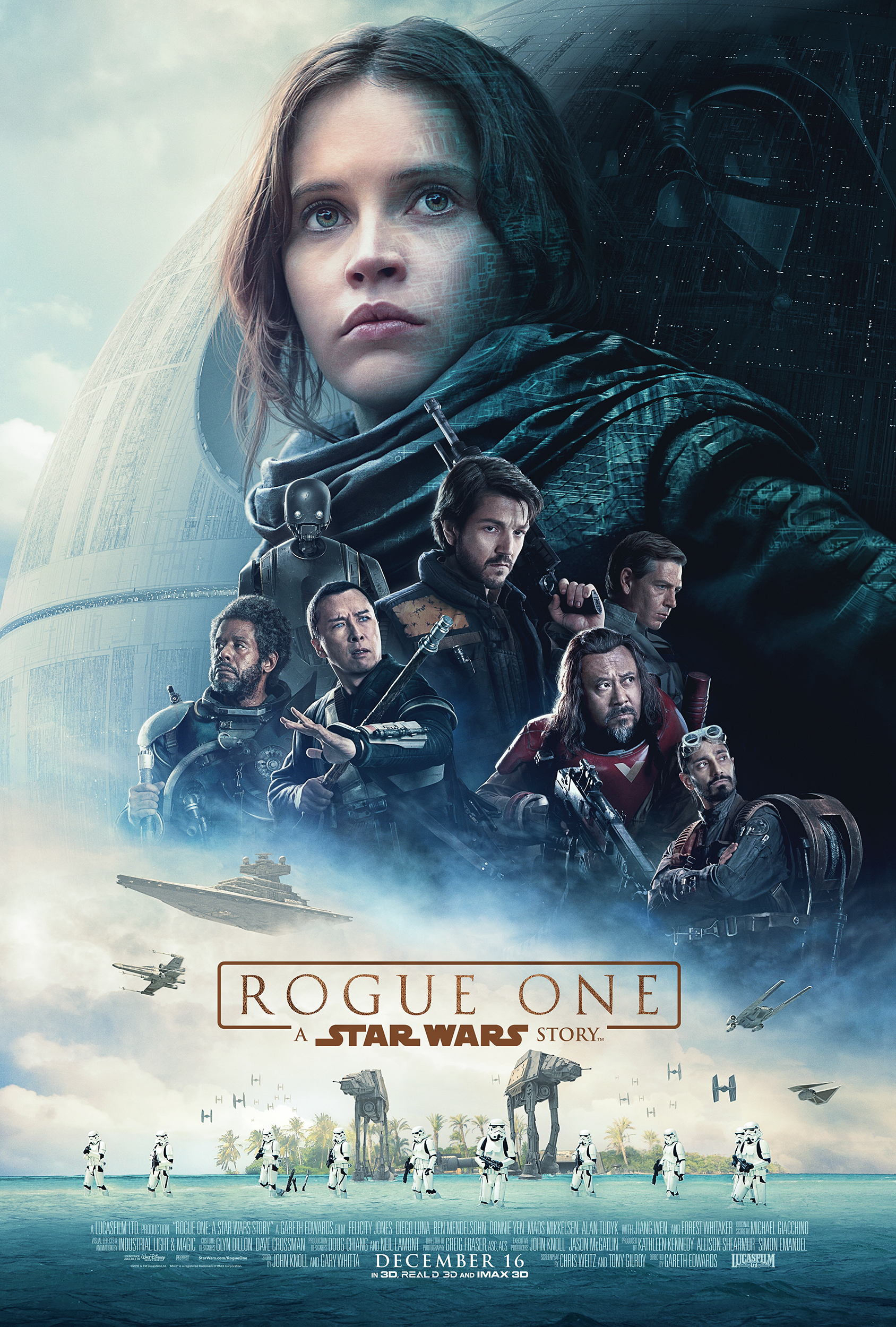
The beautiful one-sheet for “Rogue One: A Star Wars Story”
Chief among my gripes, and one of the major talking points regarding the film (unfortunately), are the fully-CGI renderings of Governor Tarkin and Princess Leia (Peter Cushing and Carrie Fisher circa 1977). Many have grappled with the ethics of using the likeness of the deceased Cushing (which I don’t see as an issue), and it will be interesting to see how Fisher’s character will be used in future installments after her tragic and untimely passing. My bugaboo is that the characters didn’t look great on the screen, and the distraction hardly seemed worth the trouble. Leia was the more convincing of the two, but I imagine her minimal screen time helped a bit. Tarkin, as well as Cushing himself, is iconic, and while I like the idea of him having a presence in the story, he didn’t need to be a fully-fledged character responsible for anchoring multiple scenes. The likeness was not quite good enough for that and resulted in a distraction that makes a Star Wars fan powerless to think about anything but the weirdness of seeing a major character in a modern movie played by an actor long dead. Not a movie-wrecking travesty, but a distraction nonetheless.
This serves as a natural segue into a few other pain points revolving around how Rogue One related to the canonical Star Wars episodes. [Prepare yourself for a paragraph of petty beefs followed by what I actually liked about the movie… I promise.] Darth Vader appeared in a couple of scenes. In his scene with Krennic (Ben Mendelsohn), you might notice that Vader doesn’t appear quite himself. Whether the great James Earl Jones’ (now 86) iconic timbre isn’t what it used to be, or the costume wasn’t quite right (I’ve heard many diagnoses, but haven’t been able to put my finger exactly on it), the small details in this scene were bound to distract longtime fans and could have been altogether avoided without harming the story if the scene were trimmed. Jimmy Smits was a welcome sight, but did he have to come with a verbal reference (might as well have been a wink) to Princess Leia—especially when you’ve already got her lined up for a killer cameo later on? It’s just a matter of redundancy bogging down the proceedings when subtext would suffice. There are other pocks, but I’m going to stop now before I forget that I actually really liked the movie a lot. Read more…
In 2002, director Danny Boyle and screenwriter Alex Garland unleashed 28 Days Later upon an unsuspecting public. This low-budget zombie outbreak thriller is arguably the impetus for the collective fascination with zombies that has festered ever since, cresting with TV’s The Walking Dead.
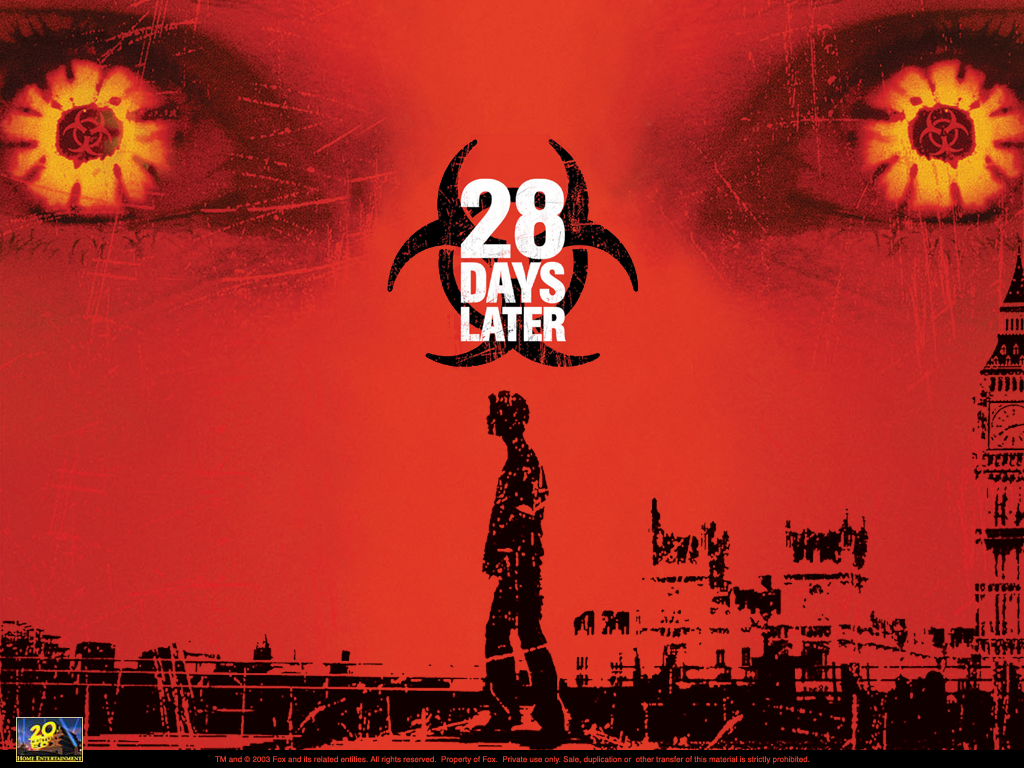
While the first Resident Evil adaptation hit theaters a few months before 28 Days Later, it was the latter that forged a new path for screen zombies. It was also the first to feature running zombies. Not just running zombies, but sprinting, infected rage-beasts. These more dangerous iterations instantly became much scarier than the cuddly-by-comparison zombies of George A. Romero’s revered saga that had been kicking around for the past several decades.
Though not really zombies in the traditional sense, but humans (possibly still somewhat alive?) infected by an incurable rage-inducing virus, the parallels for these new and improved deadites are strong enough to defy nitpickery. They bite, they scratch, they flail, and any resulting contact with exposed blood, saliva, unshielded corneas, etc., means for a rapid and ugly end (if you’re not ripped limb-from-limb first that is). For an IRL analog, imagine a naked person running at you full speed. To what lengths would you go to avoid getting the naked on you? If said naked person really wanted to make an uncomfortable amount of naked contact with you, then to what extent would you even be able to prevent it? Yeah, scary. Read more…

Scified.com
“Now have you thought of what animal you’d like to be if you end up alone?”
You already know the tantalizing premise. Single folk are shipped to a hotel for a 45-day stay. In that time, they must find a compatible partner, or be turned into an animal of their own choosing. David (Colin Farrell) tells the hotel manager that, should it become necessary, he would like to be a lobster—hence, The Lobster.
It’s a desperate scenario, and one that widows and sad-sacks seem generally resigned to, complacent even. It’s not until fairly deep into the movie that the machinations of the damaged souls who would rather not be turned into some sort of house pet begin to show. Some guests fake certain characteristics in order to seem more appealing to prospective partners. Some enter into uneasy relationships and only to have their overlords assign them children—you know, in order help smooth things over. Some have have difficulties adapting to the rules of the hotel, and have their hands toasted as punishment (any movie trafficking in absurdity is really only as good as its non-sequitur game—and The Lobster’s game is strong). Read more…
Sphere kind of came and went in 1998. It was a big-budget production—and still looks it—that got poor reviews and lost money, even counting the international box office. That was the life cycle for many movies before the streaming revolution. Today, it seems most movies are counted on not only to earn most of their ticket stubs internationally, but to find their audiences over an extended period of time through streaming and home media.
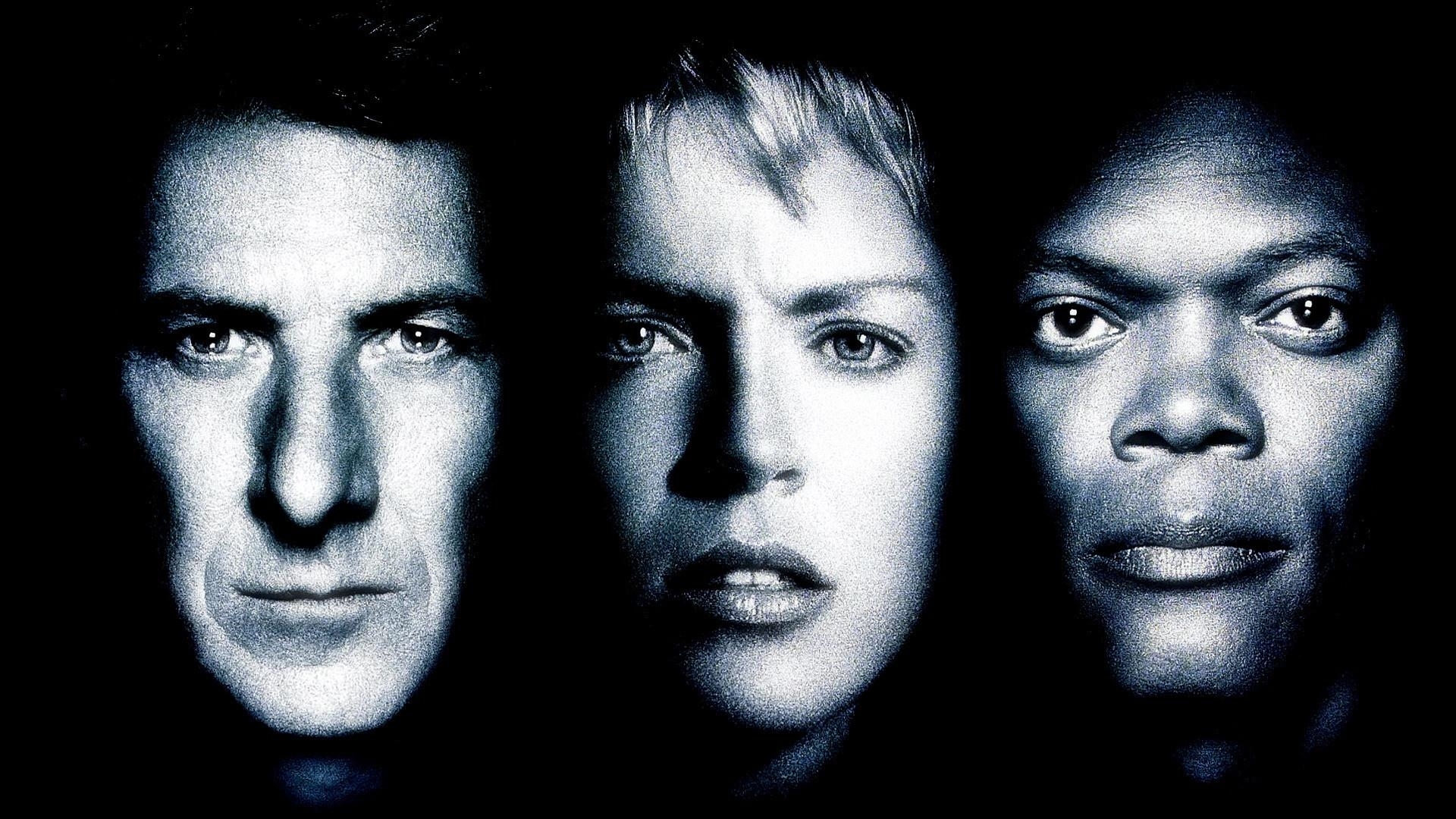
Image courtesy fanart.tv
Sphere was not something I saw when it had its theatrical run but, always the sucker for science fiction, I couldn’t help queuing it up recently when I saw that it would soon expire from Netflix. Those expiration dates are never really set in stone, but if you’re reading this, then the aforementioned expiration date (June 1, 2016) has probably passed.
Adapted from Michael Chrichton’s novel of the same name, Sphere, embraces the feel of a novelistic adaptation. The slow build-up is paced just right for getting to know the characters and feeling a distinct sense of wonder. There are even chapter headings. I don’t have a good answer for why some movies choose to disrupt the narrative with title cards announcing new chapters. It probably works really well somewhere, but I can’t think of an example that isn’t distracting, and in this case, the distraction doesn’t serve much purpose other than reminding us, “hey, don’t forget that this is based on a Michael Chrichton novel.” Read more…
 Our Planet Burke