
I pride myself in making the effort to watch all kinds of films but I must admit there are a few factors out there that can occasionally give me trouble. The first is length. I watch a lot of movies on Netflix that I have little to no background on. When a movie is well over two hours, I will likely bump it down the list. The closer it gets to three hours, the more I will have to think about just how badly I want to watch it.
Two other common obstacles I encounter are those that come with watching foreign and silent films. Lumping these together hardly seems fair, but with both sets of films, I am not hearing my native language spoken. Sometimes, this is a barrier to entry, but it generally fades away when I start watching. Invariably, I always watch what I want to watch, despite any of these perceived obstacles. I just think it’s healthy to admit they exist.

“Woman in the Moon” A Film By Fritz Lang
I recently viewed The Woman in the Moon, a silent-era German film from 1929. At 169 minutes (according to Netflix), it checks all of these boxes with great relish. One benefit of watching a foreign silent film, is that the language barrier effectively doesn’t exist. As there is no spoken dialogue, all lines are shown on cards (a.k.a. “interstitials”), conveniently translated. Read more…
If you didn’t already know, or haven’t already heard, 2013 was a mighty impressive year in film. Unfortunately, you wouldn’t know it by looking at the Academy Award nominations. In the eight most-ballyhooed categories (Best Picture, Director, both Screenplay and all four Acting categories), a mere 12 films account for every last nomination. Awards parity, at least in the nomination phase, is a true sign of a great year in film.
But don’t let the lack of parity fool you, 2013 was legit.
I haven’t gotten around to seeing all of the Best Picture noms yet but here is my progress report and the chances I feel each film has to take home the big prize at the end of the night.

NBC’s Community is a few weeks into its fifth season and that means my comments are overdue. Honestly, I’m proud but also a bit surprised the show has made it as far as it has; a fifth season, scheduled to run through the 97th episode of the series. What does this new season hold in store for its faithful?

Community has been reinvented. A new slate. The new debut episode was even titled “Repilot”. The first few episodes have built a new veneer of promise thanks, in part, to the return of original show-runner Dan Harmon and his repertory writers and producers.
While this is certainly cause for celebration amongst the show’s die-hard fans (as if there were such a thing as a non-die-hard Community fan), NBC’s offbeat, little-sitcom-that-could finds itself in an unexpected position. Here it is, sitting on the precipice of 100 episodes (again, 97, unless a sixth season is in the cards), after facing seemingly-impending cancellation since season two.
If you have followed any of Community’s season-to-season renewal madness, you have likely heard about the unceremonious sacking of Dan Harmon following his public spat with star Chevy Chase in 2012. This led to a disappointingly directionless and merely decent fourth season.
With the return of Harmon (and his buddies Chris McKenna, Dino “Starburns” Stamatopoulos, and the Russo brothers), fans have reason to believe Season Five will mark a return to former glory. I have always been one to wave the Greendale flag, but I still have my reservations about the reunion of the show’s creative powers. Will Harmon be the same drunkenly destructive (and admittedly passionate) force he was in the past? If he is, it could very well mean a brilliant return to form, or just as likely, another canning and subsequent heartbreak for fans.

The way I see it, the best case scenario for the legacy of Community has come and gone: full-on cancelation after the third season. I’ll mention it again; with the specter of 100 episodes looming in the not-too-distant future, even if Community never hits that mark, any comparisons to Arrested Development are long gone. After all, 5+ seasons and 100+ episodes would be a far cry from the initial 3/53 run posted by the Bluths (granted, Arrested has since been revived on Netflix).
In it’s early seasons, the Greendale Human Beings. made me laugh and cry with the urgency of a group that knew it all could (and likely would) end at any moment. Even the Harmon-Chase turbulence managed to serve as an appropriate meta-framing device for the decidedly dark turns of Season Three. And by “decidedly dark turns,” I mean that this was the single-darkest season of any television series I’ve ever seen, Breaking Bad be damned.
Maybe I’m just scraping the most curmudgeonly depths of my fanboy barrel, but at this point I feel Community really missed out on an opportunity to be the next great example of a show shamefully cut down in its prime, in the time-honored tradition of Firefly, Arrested, Deadwood, etc. Somehow, the possibility of joining those ranks always comforted me when I feared the inevitable doom. That comfort is now gone.

I do think it’s a testament to the rabidity of the fan base that this show is always left sitting on the back burner, even if it’s depending on failures such as Whitney to continue to leave the door open just a crack. Unfortunately, there comes a time when last-second orders of 13 episodes at a time just aren’t doing a show justice anymore. I have very real fears that this show simply wasn’t built to last well past the century episode mark. I mean, can you imagine Community having a 30 Rock-esque run? I just don’t see it as that kind of show. I love 30 Rock but I would be more comfortable if the two shows didn’t share this parallel. Community is every bit as good, but how does a show about disparate community collegians that otherwise defies categorization manage to last this long?
Don’t get me wrong, I’m happy to be able to spend more time with the best ensemble comedy cast to grace any television screen in the past five years. The beginning of this new season has been funny, and thankfully, a little lighter than Season Three. I hope it can strike something resembling the balance found in Season Two (the best to date) and I look forward to watching its criminally-short 13 episode order unfold. Jeff Winger and Co. are back, and while this can only be a good thing for the here and now, eventually you have to ask the question; Will Community ever reach the point where we, as fans, would have preferred a brilliant burn out to a few gimpy final seasons? Here’s hoping the answer is a resounding “no”.
Pandorum. Melancholia*. Prometheus. Oblivion. Elysium. What’s with these mythologically-lugubrious single-single word titles lately? Whether it is a sci-fi trend, a coincidence or a sign of the times, I think it’s worth noting. Anyway, we are here to talk about the one film above that has just hit theaters: Elysium.
Elysium comes to us from writer/director Neill Blomkamp. It arrives four years after Blomkamp’s revelatory 2009 debut; District 9. The quality wrung from District 9’s miniscule budget (estimated at $30 million) and unknown cast surprised everyone. Elysium, is an entirely different story; flaunting an estimated $100 million budget and a pair of Hollywood A-listers (Matt Damon and Jodie Foster).
Without giving anything away, here is a quick primer on the story: Earth’s wealthiest have moved to a space station called Elysium. Everyone else still lives on grimy old Earth. Citizens of Elysium have the technology to heal all ailments and stop the aging process. The many Earthlings in need of such omnipotent medical assistance are not allowed on Elysium and are barred with extreme methods. Earthling Max (Damon) decides he’s not gonna take it anymore and assumes a mission to infiltrate Elysium.
Matt Damon gives a reliably heroic performance as the lead, Max. He seems curiously miscast as a wise-guy felon trying to turn his life around, but it’s not necessarily to the film’s detriment. Suffering from an accident at work, Max needs Elysium’s medical technology to save his life. To get there, he dons an exo-suit that allows him to attain vital data as well as do battle with Elysium’s droid officers. The suit is one of the key elements in the story and easily one of the most memorable. For Max to wear the suit, it must be drilled into his bones – a very nice flourish by Blomkamp. It’s a plot device, but it’s gruesome and monstrous and lends the anticipation of something terrible every time Max finds himself in a jam.

Jodie Foster, the other big name, plays a nasty politician with zero tolerance for Earthlings intruding on her precious Elysium. She lends real gravitas to her role even if her futuristic accent doesn’t always play well.
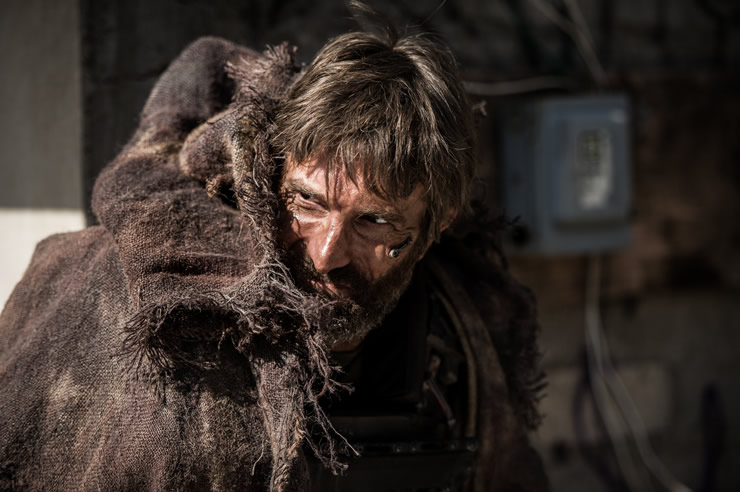
The real gem of the cast is Sharlto Copley, a long-time collaborator of Blomkamp’s. He gave an unforgivable lead performance as Wickus in District 9 and plays Kruger, a fiendish Elysian agent unleashed to stop Max. Copley is an incredible actor and plays this devious Elysian outcast-living-on-Earth, with a ruthless bloodlust. Kruger is the most memorable character and the best single element of the film. He is a contradiction of terms, serving the whims of the futuristic Elysium, yet preferring to do battle with swords, knives and even throwing stars. He is a filthy savage protecting the ideals of the “clean”.
Blomkamp provides very strong direction, even if he seems to take too many cues from his last film. He uses a strong, stylistic approach that swings back and forth between two extremes to great effect. On one end, Blomkamp delivers ultra-slick Ridley Scott-esque sci-fi action, and on the other, he descends into a Cronenbergian sense of biomechanical dread. It’s a thrilling combination and I hope Blomkamp can eventually put it to good use with a story that manages to completely separate itself from District 9.
Does Elysium improve on District 9? No, it does not. It seems unfair to even compare the two even though it’s nearly unavoidable. Both films feature similarly slummy Earth conditions, a distinct South African flavor, and a flair for the kind of grotesquery associated with recent horror films. These are three ingredients that made a delicious stew in District 9, yet only managed to make alphabet soup with Elysium.
The script clanks along at times like a rusty exo-suit. The politics are not subtle. Most of the characters are uninteresting. Events often fail to play out with the maximum impact, instead taking the easy, Hollywood-ized way out and undermining the story’s power in the process.
I mentioned that the politics are not subtle. Politics don’t always ruin movies but to let them get in the way of the entertainment is unforgivable. Elysium definitely flirts with this line. It is unfortunate that a movie with so much to say takes no real care in how it delivers the message.
Blomkamp is an excellent director and Elysium is ultimately a pretty good movie. There’s nothing wrong with a movie being pretty good. Elysium’s chance to be better than that is torpedoed by an all-too conventional script and some not-so-metaphorical soapboxing. Still, see it for Blomkamp’s spectacle, and see it for Copley’s delicious villainy, but District 9 this is not.
*Admittedly, “melancholia” is not necessarily a mythological word, but boy is it ever super lugubrious.
Oblivion comes courtesy writer/director Joseph Kosinski. Kosinski has adapted his own graphic novel for Oblivion and it marks his sophomore directorial effort, after 2010’s TRON: Legacy. As trailers have made abundantly clear, Oblivion is also produced by those who brought us Rise of the Planet of the Apes (2011). As you surely know, that film achieved fame for being the first film ever reviewed on my website.

Fortunately for Oblivion, it is a better movie than both those of its’ pedigree. That said, Oblivion presents plenty of frustrations all its’ own. The presentation of the first act felt out of touch and disjointed. The first act just scream’s I Am Legend (2007), and yet instead of playing on the eerie emptiness of the post-nuclear-war Earth, we get a bombastic musical score that, while rousing, just doesn’t jive with what you’re seeing.
If movies were record producer-themed Halloween party, Oblivion went with Phil Spector when it clearly should have been gone Rick Rubin. Phil Spector, a record producer known for his signature Wall-of-Sound approach, tended to make fuller-sounding records through the use of additional sound elements. Rubin, on the other hand, is known for producing records stripped to the bare minimum of necessary sound elements. Both styles have value, but both also have their place. Think of how “Be My Baby” by the Ronettes was a huge hit for Team Wall-of-Sound, and Johnny Cash’s cover of “Hurt” was perfectly minimalist. Oblivion is an example of picking the wrong style and missing the chance to establish a coherent feeling.
The result of this misstep is a soulless first act. What follows, is better and delivered with more panache (even if the panache is mostly borrowed from other films). Oblivion doesn’t do much to separate itself from all of the other post-apocalyptic (simply typing those words makes me shudder) genre movies. 2001: A Space Odyssey, Independence Day, The Matrix, not to mention the movies I named earlier in this review and probably dozen or so more, are all present in Oblivion. Also, did anyone else see the bit taken right from The English Patient? How far and wide must one mine for obscure movie bits to shoehorn into science fiction movies these days?

While I’m at it, can we possibly just put an end to the post-apocalyptic genre altogether? An all-too large percentage of science fiction stories use this device and it’s become a steaming hot mess of cliché. I vote that this subgenre remain shelved until someone comes along with an idea that will shake things up and show us something we haven’t seen 100 times before. Such movies that have taken imaginative approaches to the subject matter in the past include Mad Max, Brazil and Delicatessen (being a degenerative movie collector, all I ever need do to find examples is gaze upon my own shelf).
If it isn’t already obvious, I love this genre. Sometimes movies like Oblivion, entertaining as they are, cause me to worry about its’ future. Another film that has made me feel this way is Eagle Eye (2008). It’s a pretty ridiculous story that owes any decent elements it may possess to better movies. Oblivion is better because the story is more interesting and somewhat less traveled. It just has the same trouble with borrowing inspiration in generally uninspiring ways.
Ranting aside, I can give Oblivion a lukewarm recommendation. Unfortunately at this point, the best way of seeing this movie (IMAX) is no longer available. However, it’s an action movie that manages to be pretty exciting while resting comfortably on a few clichés. The ending had me on the edge of my seat as I waited to see which way it would go. Would it be the unexpectedly careless ending or simply the unsurprising one? I report that I was pleasantly unsurprised. Did I mention Tom Cruise and Morgan Freeman are in this movie?

I took advantage of the recent opportunity to see Jurassic Park in IMAX 3D, and I’m so glad I did. Jurassic Park (1993) is the classic Spielbergian tale of man vs. nature, genetically-engineered dinosaurs, chaos theory and even lawyers. Although I never saw it in its’ original theatrical run, JP has always been one of my favorite movies. It was also a major part of my whopping dinosaur obsession as a tot, and do I ever have the dusty, sagging bookshelf in my basement to prove it. Read more…
 Our Planet Burke