
Quick question – Does every “big space movie” necessarily have to be a referendum on how an artist feels about 2001: A Space Odyssey? It’s entirely possible that the answer is “yes.” Whether it’s fair or not, Stanley Kubrick’s game-changing 1968 film has provided the basis of comparison for a vast number of science fiction films made in its wake. This includes Solaris (1972), Close Encounters of the Third Kind, Star Wars, Alien, the Star Trek films, and more recent fare such as Contact, Event Horizon, Sunshine, and Moon among many others.
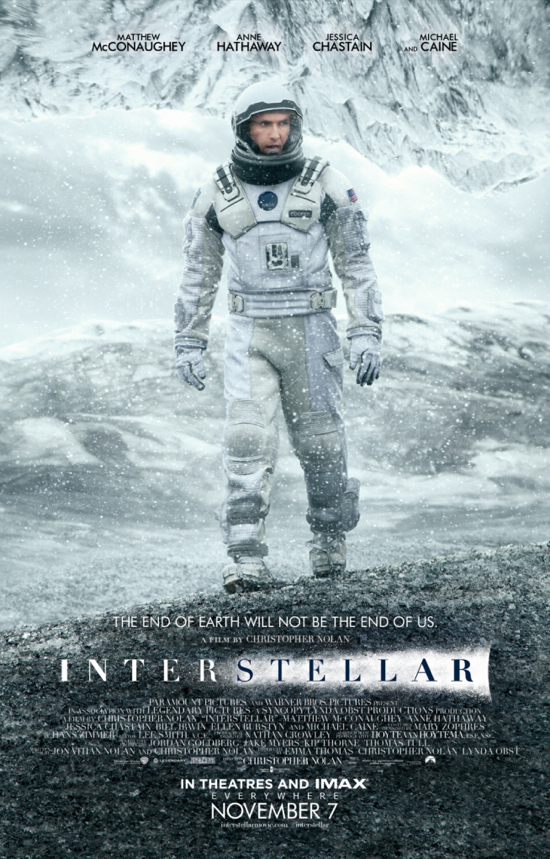
In Interstellar, blight has destroyed many of the world’s staple crops and time appears to be running out for humanity on Earth. A former test-pilot-turned-corn-farmer (Matthew McConaughey) and his precocious daughter Murph stumble upon NASA’s Area 51-esque hidden base. With more pressing Earthly matters at hand, NASA has become disreputable and is forced to operate underground. To establish a new home and save humanity, they are planning a mission to enter a worm hole near Saturn that will take them to a few suitor planets in another galaxy. In this Luke Skywalkery scenario, McConaughey’s Cooper turns out to be just the man to pilot the mission. While the astronauts (Anne Hathaway among them) scope out promising habitats, the possibility that a father may not be able to keep his promise to return home for his daughter looms. The manipulation of three-dimensional space by fifth-dimensional beings (or something like that) ensues.
There are partial spoilers ahead for two classic films. If you are sensitive to spoilers, go watch the movie first and then come back. One can be found on Netlfix, but you’re probably on your own for the other.
Invasion of the Body Snatchers (1978)

Waves of movie remakes are not a new thing for Hollywood. Take a look at the 1978 version of Invasion of the Body Snatchers, directed by Philip Kaufman. An updated take on Don Seigel’s 1956 original, Body Snatchers ’78 is more than a simple retread. It’s one of the more effective chillers of its era. Read more…
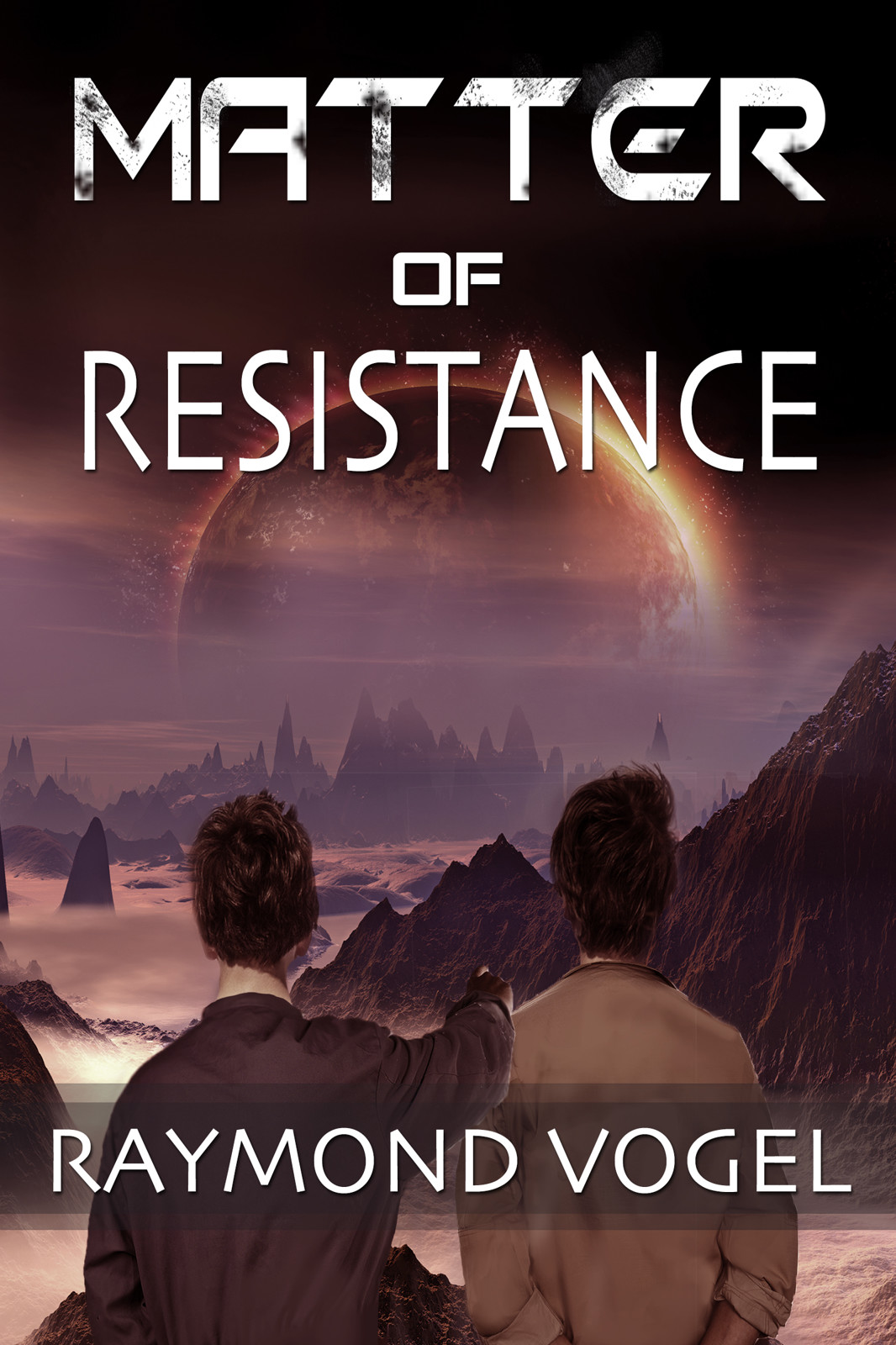
We have an exciting first for OPB! AEC Stellar Publishing, Inc. has gifted me a very entertaining e-book. The novel, Matter of Resistance, was written by first-time novelist, and former NASA rocket scientist, Ray Vogel. Vogel is also the owner of the AEC Stellar Publishing.
A Marsian child is born against the backdrop of a war between Earth and Mars. Marsians refer to themselves as such because “Martian” is a bit of a loaded term for the human settlers of the red planet. The war stems from the strained relationships caused by political differences and the limited availability of Magnematter, a valuable, enigmatic Marsian resource. Earth’s war effort appears to be spearheaded by megalomaniacal corporations that may have usurped traditional government. The stakes and tension build over the course of more than a dozen years as the young Marsian, Isaac Raleigh, matures into a generational leader, while Earth and Mars race to develop the necessary means to accomplish their ends.
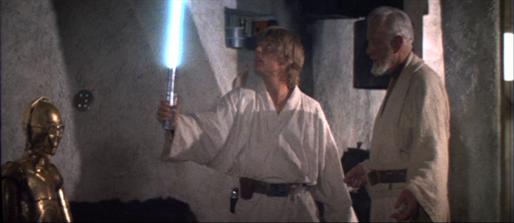
What if I told you the most iconic science-fiction film of all time isn’t actually science-fiction? It’s not. Not really. But what about the space travel, the aliens, and the laser weapons? The effing lightsabers? Sure, Star Wars superficially features all of these things (and more!). But Star Wars isn’t true science fiction. I’ve riffed on what defines the genre before, but let’s take a look at what a movie really needs to have to be satisfactorily deemed science fiction.
1. Fiction
Self-explanatory. This is why stuff like Apollo 13 isn’t science fiction.
1.5. SF stories are typically set in the future. There are a few exceptions, but listing them would require me to acknowledge Wild Wild West (whoops). Similarly, many films are not explicitly set in the future but still feature the requisite SF elements needed to separate us from the present as we know it.
2. A “Science-Fiction Element”
Basically, you know these elements when you see them (you know, same as the definition of pornography). Some of the most popular examples are time travel, space travel, aliens, alternate dimensions/worlds, scientific/medical breakthroughs and, of course, the Apocalypse.
This element could also be pushing some everyday function to its extreme. One of the best examples of this would be The Truman Show. Tech-wise this film could be set in the present, but since it pushes the phenomenon of reality television to the extreme of staging a man’s entire life for a television audience without his knowledge is “out-there” enough for this to be a science fiction film. Let’s call this one the “Socio-Sci-Fi Corollary.” Read more…
I reviewed the last Rise of the Planet of the Apes in my first ever entry on this site. I was a little surprised by the success of that film, and when I started seeing trailers for Dawn of the Planet of the Apes, I couldn’t help but think that sometimes you just need to let the damned-dirty apes lie. Once again, I was not prepared for the success I was about to witness. Alas, Dawn is excellent. Allow me to wade through a few tangents as I unspool my thoughts on this gem from director Matt Reeves.
Cinephile circles ought to be buzzing about just what it is Andy Serkis will need to do to earn an Academy Award nomination for all of his performance-capture glory. I don’t know if any of the Apes financiers have the desire to push for a Serkis Oscar win (or even nomination), but they had better make up their mind while Serkis still seems to have a stranglehold on performance-capture acting. Maybe they should just credit him as one of the visual effects artists in the next film. Supposedly, the amazing Judy Greer (Arrested Development) played one of the apes in Dawn. I say “supposedly,” because one would never really know, and perhaps that is part of the nebulous issue of how performance-capture translates to actual acting.

I think I’ve found what’s been missing from recent Science Fiction. All I had to do was go back about forty-eight years to Richard Fleisher’s Fantastic Voyage (1966). This is not to say SF has been sparse. Quite the contrary, SF has been loaded, overloaded in fact, with post-apocalyptic tales, super heroes and remakes. When I say I’ve found what has been missing, I’m referring to more of a spiritual deficit.
The key ingredient I so joyfully experienced with Fantastic Voyage was delivered in the odd form of a title card.
“This film will take you where no one has ever gone before; no eye witness has actually seen what you are about to see,” it boldly claims. It goes on,
“But in this world of ours where going to the moon will soon be upon us and where the most incredible things are happening all around us, someday, perhaps tomorrow, the fantastic events you are about to see can and will take place.”

Fantastic Voyage, 1966
 Our Planet Burke