
Mickey 17 (after a few other random thoughts)
With awards season now in the rearview, screenplays have been on my mind. Whether focusing on films nominated for their original or adapted screenplays, the nominee pools for these writing categories often comprise the most interesting films – at least for my money. It is said that films are made three times: when they are written, when they are shot, and when the are edited. Using that lens, perhaps it’s the relative purity of a fully-formed idea of a movie that makes screenplays seem especially worthy of extra attention.
While films nominated for their “original” screenplays generally align with each year’s cream of the crop, it is always fascinating to see the sheer range of projects that are inevitably crammed into the ostensibly straightforward category of “Adapted Screenplay.” Here are some of the usual suspects:
- Faithful, beat-for-beat adaptations from another medium.
- Sequels (literal sequels or something more spiritual) – Silence of the Lambs comes to mind. It was adapted from a Thomas Harris novel, but also builds upon the cinematic legacy of a previous Harris adaption and Michael Mann film, Manhunter.
- Sometimes we get something a little more radical, such as Greta Gerwig’s Little Women which infused a very familiar familiar story with other writings and biographical information from the life of author Louisa May Alcott.
- Sticking with Gerwig for a minute, Barbie created another wrinkle in the landscape of adapted screenplays, as her 2023 smash hit demonstrated that toy marketing collateral apparently qualifies as adaptable source material.
None of this has much to do with Mickey 17, though Bong Joon-ho’s latest film is particularly interesting to me from a screenplay perspective. I had read the novel immediately prior to seeing the film on its opening Friday. It didn’t take long to realize I did myself a disservice going in with the novel so fresh. In the grand history of film adaptations not porting over original stories on a one-to-one basis, this tension is nothing new. Edward Ashton’s novel (“Mickey 7” – note the slight title alteration) is not exactly the kind of story I’d have pegged for a big-budget studio farce. The novel has a low rumble of wise-cracking humor throughout but it’s primarily a work of rigorous science-fiction with an enthusiasm for philosophy.
I’ll spare the gory details of “what’s in and what’s out” because such parsing is tedious and never creates a level playing ground for evaluating the film in question. It suffices to say that there are some concepts, characters and beats that I was excited to see adapted for the big screen that did not make it into the film. I am trying not to hold this against Mickey 17, but again, I put myself in a tough spot.
Fortunately, I also love Director Bong’s entire filmography, which is loaded with other films that are often darkly comedic and satirical. The much-celebrated filmmaker from South Korea took home four Academy Awards for his 2019 film, Parasite (Best Picture, Best Directing, Original Screenplay, and Best International Feature). My love of his films makes the resultant Mickey film easier to swallow. Sure enough, if you’re a fan of Director Bong, Mickey 17 slots in alongside his other English-friendly features, Snowpiercer and Okja. Adding Mickey 17 to that pair, these films all offer a zany brand of humor along with the filmmaker’s humanism (interestingly, his humanism morphs into something darker in his Korean-language films), love for animals, and disdain for the absurdity and chaos wrought by modern capitalism. While that isn’t the exact mix of qualities I’d have amplified at the expense of everything else in Mickey 7, it’s not a total surprise that Bong saw the story’s core elements as a compelling building block for him to do his own thing with.
Okay, enough with that. We can sidestep my handwringing over digressions from the novel and discuss the film that is currently in theaters…
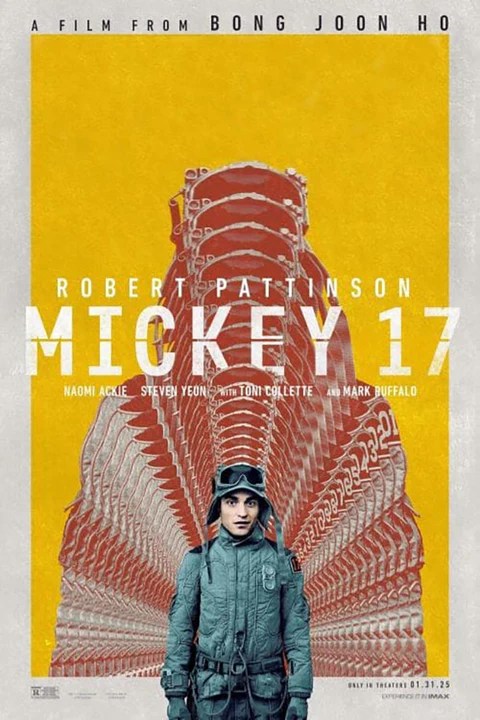
Mickey 17 is a fun and funny romp about a future generation’s attempt to colonize a faraway, semi-hospitable world. The hook is that the colony employs an expendable named Mickey Barnes whose body can be reprinted and consciousness can be backed up and uploaded into each new instantiation. As the expendable, “Mickey 17” (the latest instantiation) gets assigned to the colony’s dangerous and exploratory assignments. Mickey 17 is (along with some other Mickeys), portrayed by Robert Pattinson, who delivers admirable accent work and physical comedy in his multiple roles.
The colony mission is led by the insecure wannabe-dictator, Kennneth Marshall (Mark Ruffalo), and his dipping-sauce-obsessed wife, Ylfa (Toni Collette). These buffoonish caricatures are drastic departures from the text, and provide the kind of broad, zany comedy that gets some laughs but does not offer much in the way of serious critique (one might even say that barking dogs never bite). The skewering of recognizable political and other forces in our modern world is appreciated but it feels fair to say there was some missed opportunity here. The aforementioned Snowpiercer and Okja are also somewhat divisive among Bong Joon-ho’s filmography for how they balanced deeper ideas against more farcical elements.
Naomi Ackie co-stars as Nasha, Mickey’s non-expendable colleague and love interest. If you’re not familiar with her, she’s a huge talent who has recently starred as Whitney Houston in I Wanna Dance With Somebody and the 2024 thriller Blink Twice. Their relationship is sweet and heartfelt and among the elements that works best in the film. Pattinson and Ackie have great individual presences and chemistry. The film springs to life whenever they are present.
Steven Yeun is also a delight in this film (as always) despite the bizarre rendering of his character, Timo. This character (named Berto in the book) is Mickey’s slick but unreliable best friend who gets them both into jams. On the page, Berto has a more fully-realized relationship with Mickey and is far more integral to the novel’s philosophical and ethical themes. Credit goes to Yeun for lighting up the screen despite the strange and reductive adaptation of that character.
Bong’s love of creature features finds purchase with the grub-like beasts known as “creepers.” Alternately terrifying and adorable, the misunderstood creepers fit neatly into the lineage of creatures he has brought to the screen, including the kaiju from The Host and Okja the super pig. These hairy, many-mandibled crawlies are a charming feat of design and effective in helping to hold the sprawling story together. Speaking of design, the overall production design of the film is immaculate. The sets and costumes create an entire world and help bring the story to life.
Mickey 17 probably could have been a titanic work of 21st century science fiction up there with other modern classics such as The Martian, Arrival, and Annihilation. The novel packs enough heft to support a film of that caliber, but for better and worse, the film we ultimately got takes things less seriously. Director Bong’s idiosyncratic adaptation plays fast and loose with the most interesting parts of the novel which makes the movie seem unwieldy in comparison. Changes in some of the characterizations will cause consternation among viewers who read the book first.
To the film’s credit, there are parts of the novel that came across as practically unfilmable which meant the adaptation process was always going to require some difficult decisions. It’s a first-person story with an extremely chatty narrator, some of which translated into the film while much of it of was necessarily excised. And for all its virtues, the novel is anticlimactic. Emotionally climactic maybe if we’re being generous, but not the kind of climax you’d expect to get in a science-fiction film a major studio is dropping roughly $150 million on.
The bottom line is that Director Bong is a great artist who took the bones of a good story and made it his own. Love it or hate it – the adaptation has its share of questionable elements – Mickey 17 is still hugely ambitious and a lot of fun. See it for the director. See it for the lead actors. See it for the filmmaking and design. There should be more big budget films operating with this level of quirk.
 Our Planet Burke